
Important information
The most important safety tips for your trip.
Safety is our top priority. That’s why we’ve put together the most important information about your holiday here for you.
Before setting off
Before setting off
- Make sure that all skylights, windows and doors are closed.
- The step and crank supports must be retracted and securely fixed in place.
- Gas appliances must be switched off.
- In many European countries, gas cylinders must also be sealed.
- Securely stow away all loose items – they can become dangerous projectiles if you brake sharply. Also, make sure cupboard doors and the fridge door are firmly closed.
The vehicles at DRM
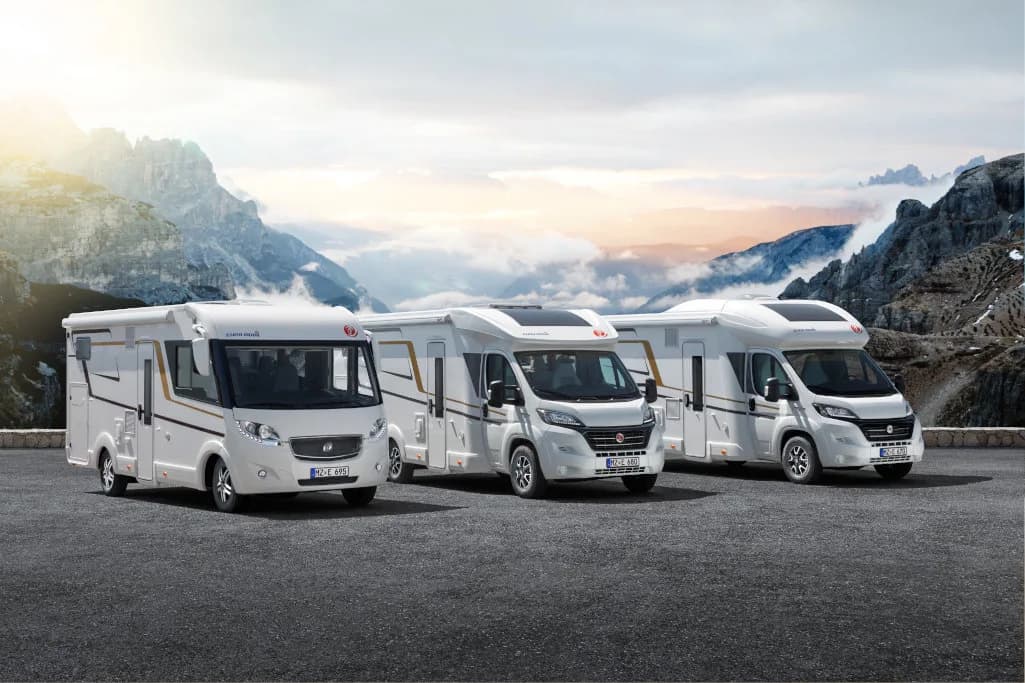
To ensure your journey goes smoothly, please note the following information regarding our vehicles.
Good to know
- Bicycle racks are available for all vehicles. Please check the load capacity of the relevant rack before setting off.
- The oil level should be checked when refuelling, or at least every 1,000 km. If necessary, use 5W-30 oil for diesel engines (for the VW California, ensure it complies with VW specification 507 00).
- Check tyre pressure regularly (figures for cold tyres – see table below).
- Please note the clearance height and allow for a safety margin of approx. 20–30 cm. Any damage resulting from failure to observe this is considered gross negligence and will not be covered by the insurance.
- Please be aware of the vehicle width – on motorways where roadworks are in progress, the left-hand lane is usually restricted to 2.00 m and is therefore closed to our vehicles.
- The awning (on the right-hand side when travelling) is sensitive to wind and rain – retract it in light wind, in the rain, overnight and when leaving the vehicle.
- Empty the waste water tank and toilet whenever possible. Before long journeys, fill the fresh water tank to no more than one-third of its capacity – this saves weight and fuel.
Tyre pressure (cold tyres)
You will also find the relevant figures for your hire car on the door pillar by the driver’s door.
Check the information before crossing the border
Tolls
Almost all European countries charge tolls. These vary considerably and are levied in a wide variety of ways. You should therefore make sure you check the current regulations in the relevant country before crossing the border.
In the event of accidents at home or abroad
What to do in the event of an accident
- Stay calm and secure the scene of the accident.
- Pull over, switch on your hazard warning lights, set up your warning triangle (50–150 steps away) and put on your high-visibility vest.
- Administer first aid and look after the injured.
- Call the ambulance service/police (in the event of injuries, significant damage to property, a hit-and-run accident or if the other party cannot provide proof of insurance).
- Preserving evidence yourself: make a note of witnesses’ addresses and take photographs of the scene of the accident.
- Fill in the accident report and get the other party to sign it – but do not sign any admission of liability.
- When speaking to the police: You must provide your personal details and vehicle details. If you are unsure about the circumstances, do not provide any further information.
In the event of technical problems
In the vehicle folder, you will find user manuals for the control panel and all technical equipment. Please read these thoroughly if necessary – this will help to avoid many operational problems. Minor faults costing up to €150 (e.g. a flat battery, new wiper blades) can be repaired or replaced without consulting us, and we will reimburse you for the cost upon presentation of the original receipt.
In the event of technical problems, please contact the vehicle manufacturer’s relevant emergency number, the DRM breakdown service or one of our service centres. If you encounter problems with the bodywork, our service centres will be happy to assist you. Please report any faults that cannot be fully rectified whilst on the road to the service centre in advance.